How to Break In New Climbing Shoes Without Ruining Your Feet
Quick Answer: Leather uppers stretch up to about a half size; synthetic uppers barely stretch at all. Nothing about the sole, rand, or last changes length meaningfully. So buy for snug with flat or gently curled toes and no dead space, not for pain, and break them in with short sessions on easy terrain - 20 to 30 minutes for the first few outings, increasing gradually over about two weeks. Shoes that require you to take them off between every climb are too small, and staying in them causes real damage over time.
Someone at the gym told you they should hurt. Someone else said size down two full sizes. Both pieces of advice come from an era of stiff leather shoes that no longer describes most of what is on the shelf, and following them is how climbers end up with bunions, nerve pain, and a permanently deformed toe box.

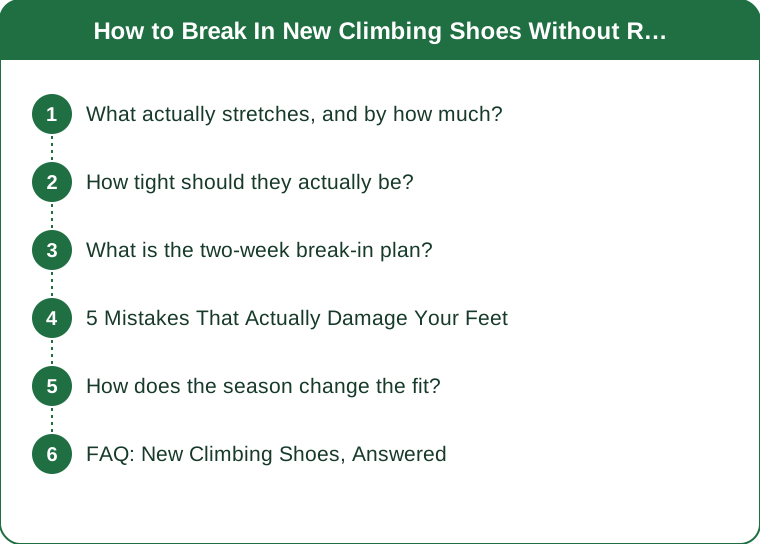
What actually stretches, and by how much?
Unlined leather stretches the most - often a full half size, sometimes a bit more. The leather relaxes and molds around your foot as it absorbs moisture and heat. This is the shoe type the size down aggressively advice was written for.
Lined leather stretches less, roughly a quarter size. The lining restrains the upper, which is the whole point of it.
Synthetic uppers barely stretch at all - maybe a fraction of a size, mostly from packing out rather than genuine stretch. Most modern performance shoes are synthetic or heavily synthetic, so if you size down expecting stretch that never arrives, you own a painful shoe permanently.
Nothing stretches in length at the sole. The rubber sole and rand do not grow. What changes is the volume of the upper, which means a shoe can become more comfortable around the foot without your toes gaining any room.
Read the material description before choosing a size. This one fact does more for fit than any sizing rule of thumb.
How tight should they actually be?
Snug everywhere, painful nowhere. Your toes should reach the end and be flat or gently curled, depending on the shoe’s design. There should be no air pockets under the arch or at the heel, and the heel should not lift when you rock onto your toe.
The realistic test: can you stand in them for five minutes without wanting them off? If not, they are too small. Discomfort you notice is normal at first; pain that dominates your attention is not.
Downturned aggressive shoes feel tighter for a given size because they hold your foot in a curled position. Beginners frequently buy an aggressive shoe a size too small and conclude that climbing shoes are just agony.
Your feet swell during a session and across a day. Try shoes on in the afternoon, and expect a shoe that fits perfectly at minute one to feel tighter at minute forty.
Have two pairs if you can. A comfortable pair for warming up, volume, and long sessions, and a tighter pair for your project. This is what most experienced climbers converge on, and it is far kinder to your feet than one very tight pair worn for everything.
What is the two-week break-in plan?
Days 1 to 3: 20 to 30 minutes of wear per session, easy terrain only. Warm-up grades, slabs, big holds. Take them off between problems. The goal is a few short cycles of heat and pressure, not endurance.
Days 4 to 7: 45 minutes, still mostly easy, with a few harder problems. By now leather will have started to give. Synthetic will feel slightly less rigid but essentially the same size.
Week 2: normal sessions, with the new pair used for the harder half and your old pair for warming up. This is the point where the shoe should start feeling like yours.
Wear them at home for ten minutes at a time. Warm feet inside the house, standing and shifting weight, does a surprising amount for a leather upper without any climbing load.
What to avoid entirely: heat guns, hot showers in the shoes, and freezing water bags. These either degrade the adhesives holding the rand on or stretch the upper unevenly. The internet is full of these and they ruin more shoes than they help.
Thin socks for the first few sessions are legitimate, especially for leather. They add a small amount of volume, protect your skin while hotspots form, and come off once the shoe has given.

5 Mistakes That Actually Damage Your Feet
1. Sizing down for stretch that will never come. The single most common and most expensive mistake, and it is entirely avoidable by reading whether the upper is synthetic.
2. Staying in painfully tight shoes across a whole session. Sustained compression of the forefoot is associated with bunions, hammer toes, nerve compression, and long-term nail damage. Climbers have measurably higher rates of foot deformity than the general population, and it comes from this.
3. Ignoring numbness. Tingling or numbness in the toes is nerve compression, not toughness. It is the clearest signal to size up that exists, and people routinely train through it for years.
4. Breaking them in on hard climbing. Steep, powerful climbing on a brand new shoe puts maximum force through your toes at the exact point the shoe has the least give. This is where the worst blisters and nail injuries happen.
5. Keeping shoes past the rand. Once the rubber rand at the toe wears through, the shoe loses structure and your toe takes load it was never meant to. Resole before the rand goes - it is cheaper and better for your foot.
How does the season change the fit?
Cold rubber is stiffer and cold shoes feel a half size smaller. As gyms and outdoor crags cool through autumn, the same shoe that fit in August will feel tight on a cold morning, and the rubber will also feel less sticky until warmed.
Warm them before you climb. Keep them inside your jacket or in the top of your pack rather than the bottom, and put them on a few minutes before your first climb rather than at the wall.
Your feet are also smaller in the cold, which sounds like it should offset the stiffer shoe - it does a little, but the shoe change dominates, and cold toes are worse at feeling small edges.
Do not buy new shoes on the coldest day of the season. They will feel roomier than they are once you are warm and mid-session. Similarly, do not buy them at the end of a long summer session with maximally swollen feet. Mid-afternoon, moderate temperature, is the honest condition.
Autumn is the best time to break in outdoor shoes because the friction is good and the rock is cool, so you can do plenty of easy volume without your feet cooking - which is exactly the conditions a break-in wants.
FAQ: New Climbing Shoes, Answered
How much smaller than my street shoe should I go?
There is no universal number, and the street-size conversion is the least useful sizing method there is. Fit is brand and model specific. Try on multiple sizes of the actual model, and pick the smallest one you could stand in for five minutes without wanting it off.
Should I wear socks in climbing shoes?
For the first few sessions of a leather shoe, yes. Long term, most people go without for sensitivity, but there is nothing wrong with thin socks - plenty of experienced climbers wear them, particularly in cold gyms.
My toes go numb after ten minutes. Is that normal?
No. That is nerve compression and it is the clearest oversizing-down signal there is. Take them off between climbs immediately, and if it happens every session, the shoes are the wrong size for your foot.
This is general information, not medical advice. Persistent numbness, joint pain, or a toe that has changed shape is worth showing to a podiatrist.
TL;DR:
- Unlined leather stretches up to about a half size, lined leather about a quarter, synthetic almost none - and nothing gains length at the sole.
- Buy for snug with no dead space and no pain, and use the five-minute standing test rather than a street-size conversion.
- Break in over two weeks with short easy sessions, thin socks early for leather, and no heat guns or hot water tricks.
- Numbness means too small, not tough - and cold autumn sessions make every shoe feel a half size tighter.
The shoes that hurt are not making you a better climber. They are costing you footwork now and toe joints later. Buy the pair you can stand in, break them in gently, and keep an old pair for the warm-up.
Keep Reading
This article is for general informational and styling purposes only. Fit, sizing, and product availability may vary.