Why Your Climbing Endurance Fades Before Your Strength Does
Quick Answer: Maximum strength and local endurance in the forearms are different qualities with different limiting factors. Strength fades slowly across a session; forearm endurance is limited by blood flow and metabolite clearance, which degrade quickly and recover slowly. That is why your hardest move is still available at minute forty but you cannot hold a jug — and why the fix is rest interval management and capillary training, not more hangboarding.
First two problems: fine. Third: harder than it should be. Fourth: your fingers open on holds you were crimping ten minutes ago.
Nothing about your strength changed in half an hour. Something else did.
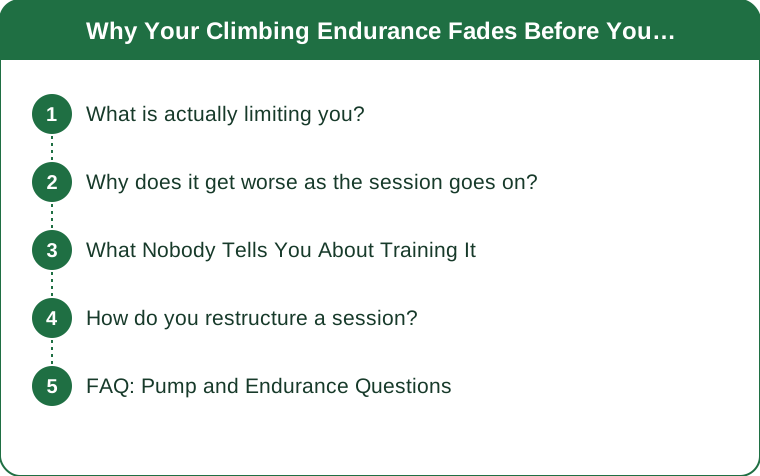
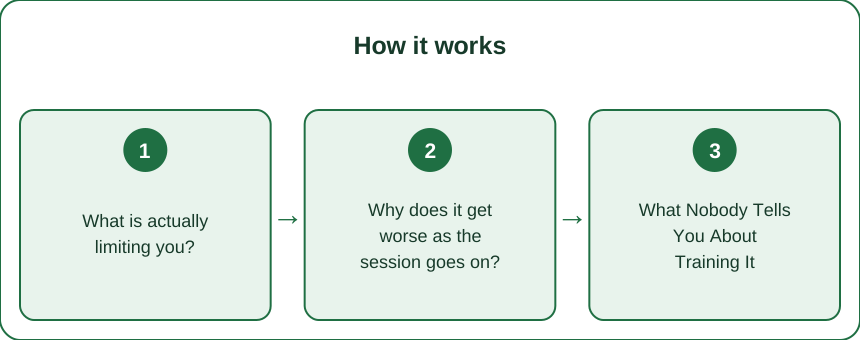
What is actually limiting you?
Blood flow, mostly.
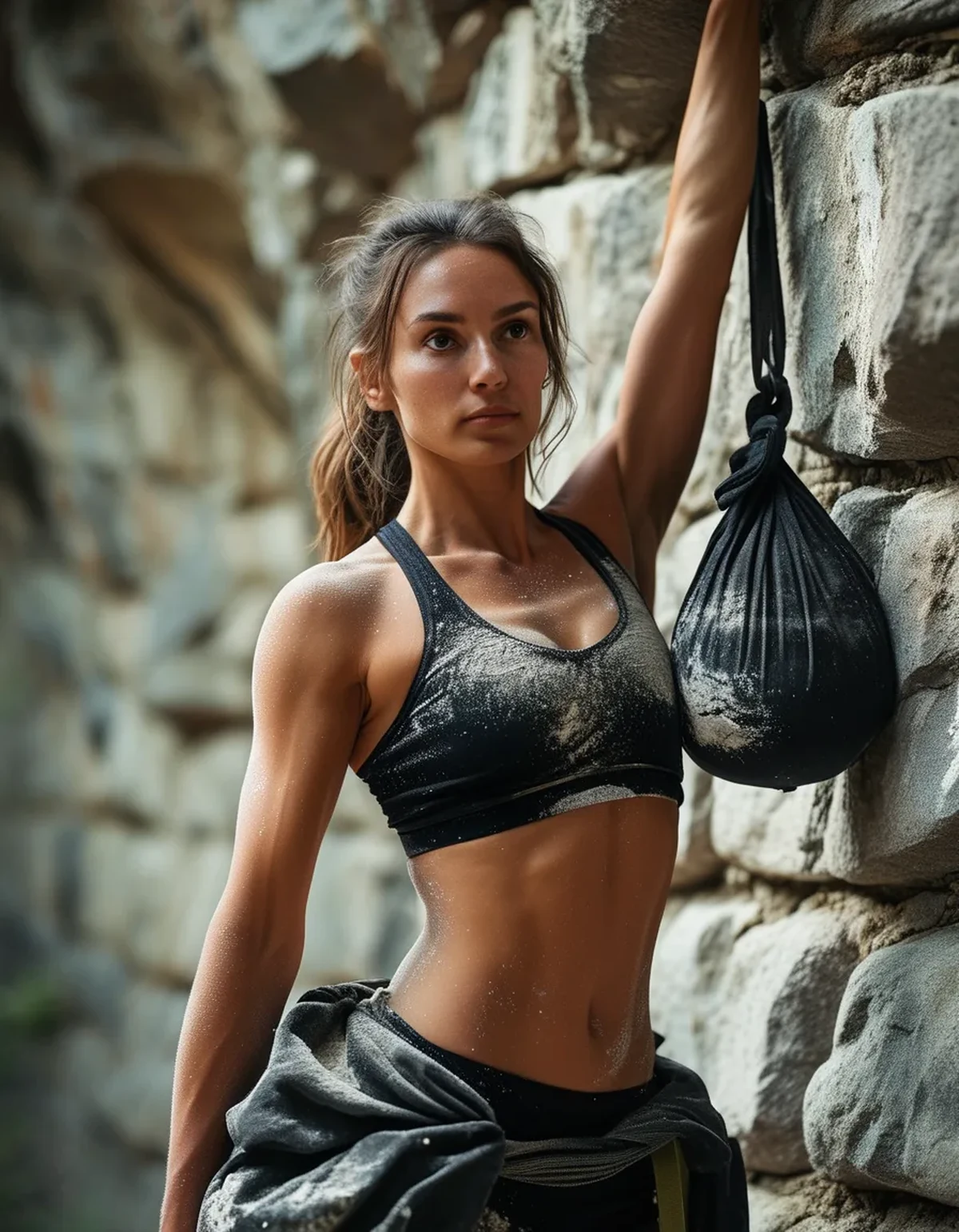
When you grip, your forearm muscles contract and compress their own blood vessels. Above roughly 40 percent of maximum contraction, blood flow through the muscle drops sharply; near maximum, it is close to occluded. That means during a hard hold, your forearm is working with limited oxygen delivery and no meaningful waste removal.
Two consequences follow. Energy production shifts toward anaerobic pathways, and metabolites accumulate — hydrogen ions, inorganic phosphate — which interfere with the contractile machinery directly. That accumulation is what you experience as the pump.
Clearing them requires blood flow, which requires the muscle to relax. Shaking out helps. Full recovery takes minutes, not seconds.
Maximum strength is limited by different things — neural drive, muscle cross-section, tendon stiffness — and those degrade far more slowly across a session. So you retain the ability to produce a hard, brief contraction long after you have lost the ability to produce a moderate, sustained one.
That is the gap you are feeling, and it is normal. What varies between climbers is how quickly it opens and how fast it closes.
Why does it get worse as the session goes on?
Because the pump is cumulative if you do not clear it.
Each burn leaves some residue. If your rest between attempts is shorter than the time needed to clear it, you start the next attempt already partly pumped. Do that four times and you have a forearm that never returns to baseline for the rest of the session.
This is the single most common structural mistake in bouldering sessions: rest is set by social rhythm, not by recovery. You rest as long as it takes for the person before you to finish, which is usually two or three minutes. For hard attempts, three minutes is not enough, and the deficit compounds.
There is a second contributor. As you fatigue, technique degrades — you grip harder than necessary, hang straight-armed less, hesitate longer on holds. Each of those increases time under tension and grip intensity, which produces more pump for the same climbing. Fatigue causes bad technique, which causes more fatigue.
And a seasonal one worth knowing right now: as gyms cool down in autumn, most climbers warm up less thoroughly and start harder attempts on colder forearms. Cold muscle has reduced blood flow to begin with, which shortens the runway before the pump arrives.
What Nobody Tells You About Training It
More hangboarding will not fix this. Hangboarding builds maximum finger strength, which is not the limiting quality here. If your first attempt is strong and your fourth is weak, adding strength work addresses the part that was already working.
The fix is capillary density and clearance, and it is trained at low intensity. Long, easy climbing — traversing, laps on problems well below your limit, ARC-style sessions of 20 to 30 minutes at an intensity you can sustain — is what builds it. It is boring, and it is why most climbers do not do it.
Rest intervals are training, not waiting. Treating rest as a prescribed part of the session, timed, is one of the highest-return changes available. For hard attempts, four to five minutes. It feels excessive and it roughly doubles the number of quality attempts you get.
Getting pumped is not the goal. Many climbers unconsciously treat the pump as evidence of a good session. It is evidence of a particular energy system being taxed, and if it arrives in the first twenty minutes it has cost you the rest of the session.
Session order matters enormously. Hard, low-volume work first, on fresh forearms. Endurance and volume second. Doing it the other way round — warming up with twenty easy problems and then trying your project — means attempting your hardest climbing on the most pumped forearms of the day.
Grip strength endurance recovers slower than you think between sessions too. Two hard sessions on consecutive days will produce a second session that feels inexplicably weak. That is not a plateau; it is incomplete recovery, and the finger tendons are on an even slower clock than the muscle.
How do you restructure a session?
A template that fixes most of this.
Warm up longer than feels necessary — 15 to 20 minutes. Easy movement first, then progressively harder holds. In a cool gym, add five minutes. Cold forearms pump faster, and a rushed warm-up costs more than it saves.
Hard attempts first, fully rested. Four or five minutes between attempts, timed. Four good attempts on a project beat ten degraded ones, and the degraded ones are where finger injuries happen.
Volume second. Once you are no longer trying anything at your limit, move into repeats and moderate problems where the pump is the point.
Finish with easy climbing, not with failure. Ten minutes of very easy traversing at the end promotes blood flow and clearance and leaves you fresher for the next session.
Cap the session at 90 minutes to two hours. Beyond that, most people are accumulating fatigue and technique degradation rather than training.
And one addition outside the session: easy volume on a separate day. A 30-minute low-intensity climbing session with no hard attempts, once a week, is the actual training stimulus for the quality you are missing. It will feel like it is not doing anything. That is what building capillary density feels like.
FAQ: Pump and Endurance Questions
Does shaking out actually work?
Yes, modestly. Dropping the arm and shaking promotes blood flow and speeds clearance a little. It works best combined with finding a genuinely relaxed position — a straight arm on a good hold does more than vigorous shaking on a bad one.
Should I train forearms with a gripper at home?
Generally no. Grippers train a crushing pattern that transfers poorly to climbing holds, and they add fatigue to tissue that is already the limiting factor. Easy climbing volume is a better use of the same recovery budget.
Why do my forearms hurt the day after rather than during?
That is usually connective tissue and muscle damage rather than pump, and it points to too much volume at too high an intensity. Persistent finger or elbow pain that lasts more than a couple of days is worth taking seriously rather than climbing through. This is general information, not medical advice.
TL;DR:
- Maximum strength and forearm endurance are different qualities with different limits.
- The pump is a blood flow and metabolite clearance problem, and it compounds when rest is too short.
- Hangboarding does not fix it; low-intensity climbing volume does.
- Restructure the session: long warm-up, hard attempts first with four to five minute rests, volume second, easy finish.
- Add one weekly low-intensity volume session and expect it to feel like nothing is happening.
The session that ends with you unable to hold a jug is not a session that trained endurance. It is a session that ran out of it in the first twenty minutes.
Keep Reading
This article is for general informational and styling purposes only. Fit, sizing, and product availability may vary.