Falling Practice: How Climbers Make Peace With Letting Go
Quick Answer: Train falling as a skill, graduated over weeks. Start by stepping off from sitting height onto the mat, then knee height, then progressively higher — landing with bent knees, arms tucked in (never straight-armed), rolling back if momentum carries you. Do 10–15 boring repetitions per session. The goal is a nervous system that has evidence the mat catches you, which is the only thing that stops the death-grip.
The wall is rarely what stops you. The imagined fall is.
You get two moves from the top, your forearms are screaming, and you know — you actually know — you could make the next hold. Instead you downclimb. Again.

Why Does Fear of Falling Make You Physically Weaker?
Because fear changes how hard you grip, and overgripping burns you out.
A scared climber holds every hold as though it’s the last one. Fingers crimp harder than the hold requires, forearms stay contracted between moves instead of relaxing, and the pump arrives in half the usual time. You get tired faster, then you get more scared because you’re tired, and the loop tightens.
There’s a second cost: fear makes you static. Frightened climbers stop moving dynamically, stop committing weight to their feet, and stay pressed close to the wall — all of which make the climbing physically harder than it needs to be.
Trusting the fall is what frees the grip. Not bravery, not psyching yourself up — trust, built from repeated evidence. The mat was always going to catch you. Your nervous system just wants receipts, and it only accepts them in the form of experience.
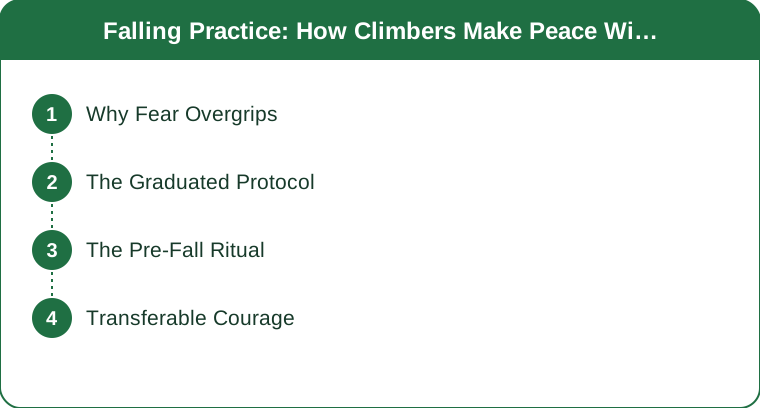
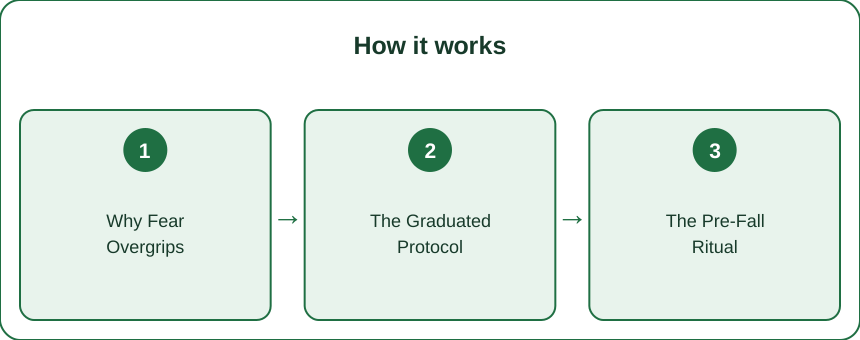
What Does Graduated Fall Practice Look Like?
The protocol is deliberately unexciting, which is the point. You’re accumulating evidence, not testing your nerve.
Session one — sitting height. Sit on the mat or on a low hold. Step off. Land. That’s it. Ten repetitions. This feels absurd, and doing it anyway is the whole method.
Session two — knee to hip height. Step off a low hold, land with bent knees, absorb through the legs. Ten to fifteen reps.
Session three — standing reach. Climb to where your feet are at chest height and drop. Now you’re falling far enough that landing technique matters.
Sessions four onward — progressively higher, moving up only when the current height is genuinely boring. Boring is the target state.
The landing technique, every time:
- Knees bent on contact, absorbing through the legs
- Arms in, close to the body. Never straight-arm a landing — that’s how wrists and elbows get injured
- Chin tucked
- Roll back if momentum carries you, rather than fighting to stay upright
- Look at the landing zone before you fall, not during
Fifteen boring repetitions build more trust than one dramatic fall, because trust is built by repetition rather than intensity.

What Should You Do Before Attempting a Hard Route?
A short pre-fall ritual, run every time you get on something at your limit.
Look down and read the landing. Where would you actually land from the crux? Is there a pad edge, a corner, another climber’s bag? Knowing the answer removes the vague dread and replaces it with a fact.
Check pad coverage. Move pads if they’re wrong. This takes ten seconds and eliminates a genuine risk rather than an imagined one.
Take one practice drop. From partway up, before you’re pumped. This converts “I don’t know what falling here feels like” into “I know exactly what falling here feels like,” and the difference in how you then climb is substantial.
Name the fall you’re accepting. Say it out loud if you’re with a partner: “if I miss this, I come off backwards onto the middle of the pad.” Specificity shrinks fear; vagueness feeds it.
Climbers who rehearse the fall climb the route braver. The unknown was always the entire monster.
5 Mistakes Everyone Makes
1. Progressing too fast. Jumping from sitting height to a top-out fall in one session teaches your nervous system that this is dangerous, which is the opposite of the goal.
2. Practicing when already pumped. Fall practice belongs at the start of a session when you’re fresh and your landing technique is sharp, not tacked on at the end.
3. Straight-arming the landing. The instinctive reaction and the one that causes wrist and shoulder injuries. Arms in. Drill it until it’s automatic.
4. Only practicing controlled falls. Real falls are unexpected. Once controlled drops feel boring, have a partner call “off” at random moments so you practice falling without preparation.
5. Treating it as a one-time fix. Fall confidence decays with time off, and it resets after any bad fall or injury. Re-run the graduated protocol after breaks rather than assuming the trust is still banked.
Is This Just Exposure Therapy?
Essentially, yes — with crash pads.
The structure is the same one used clinically for phobias: graded exposure, starting well below the threshold that triggers the fear response, progressing only when the current level stops producing a reaction. What makes it work is repetition at a level your nervous system can actually process rather than one that overwhelms it.
Climbers frequently report the effect leaking outward — the ability to proceed while holding the possibility of a bad outcome turns out to be fairly transferable. The skill was never really falling. It was continuing to move with the fall in mind.
Two honest caveats. First, fear of falling is sometimes correct — a bad landing zone, a highball, a poorly padded top-out. The goal is to remove irrational fear, not your risk assessment. Second, if fear of falling connects to a previous injury or produces genuine panic rather than nerves, work with a coach, and consider speaking to a professional if it’s part of a broader anxiety pattern. Bouldering falls carry real injury risk, and ankle and wrist injuries are common even with good technique.
Frequently Asked Questions
How long does it take to get comfortable falling?
Most climbers notice a meaningful shift within four to six weeks of practicing once or twice a week. Full comfort at height takes longer — often several months — and it’s normal for progress to be uneven, with a bad session occasionally undoing a few weeks of gains. Consistency matters more than intensity.
Should I practice falling on ropes as well as bouldering?
Yes, if you lead climb — they’re different skills. Lead fall practice requires a trusted belayer and starts with falls just above the clip, progressing gradually to falls a bit further above it. Do this at a gym with an experienced partner or a coach before trying it outdoors.
What if I’ve already had a bad fall?
Go back to the very beginning of the protocol — sitting height — even if you were falling from height comfortably before. A bad fall gives your nervous system strong contradicting evidence, and the only way past it is to rebuild the evidence base from the bottom. Rushing this after an injury is how people develop a lasting fear rather than a temporary one, and if you’re returning from an actual injury, clear it with a physio first.
TL;DR:
- Fear makes you overgrip, which burns forearms twice as fast — fear literally makes you weaker
- Practice falling as a skill: sitting height → knee height → standing → progressively higher
- Landing technique: knees bent, arms in, chin tucked, roll back. Never straight-arm
- 10–15 boring reps per session. Boring is the target state, not a sign you should escalate
- Before a limit route: read the landing, fix the pads, take one practice drop, name the fall
- Fear confidence decays — re-run the protocol after breaks or after any bad fall
- Some fear is correct information. Remove the irrational part, keep the risk assessment
The mat keeps its promises. Teach your grip to believe it.
Keep Reading
This article is for general informational and styling purposes only. Fit, sizing, and product availability may vary.