Grip Gains at Home: Training Climbing Hands Between Gym Sessions
Quick Answer: You can build climbing grip strength at home with simple dead hangs from a doorway pull-up bar, rice-bucket forearm work, and general grip carry-over exercises like farmer carries — as long as you respect a recovery rule of at least 48 hours between grip-focused sessions to protect your finger tendons.
Every new climber hits the same wall, and it’s not the one on the gym — it’s the moment your legs still feel fresh but your forearms have quietly checked out by route three. Grip is climbing’s gatekeeper, and unlike leg strength or cardio, you can’t really fake your way past it. The upside is that grip trains surprisingly well at home, between gym sessions, with equipment that borders on comically simple.

Why does grip strength give out before your legs do?
Climbing asks your forearms to do sustained, repeated work that most other activities never demand, so grip endurance lags behind general fitness for almost every new climber. Your legs might be conditioned from years of walking, running, or the gym, but the small muscles that control finger flexion rarely get trained anywhere else. That’s exactly why targeted, at-home grip work pays off faster than almost any other climbing-specific training you could do.
What’s the single best at-home grip exercise?
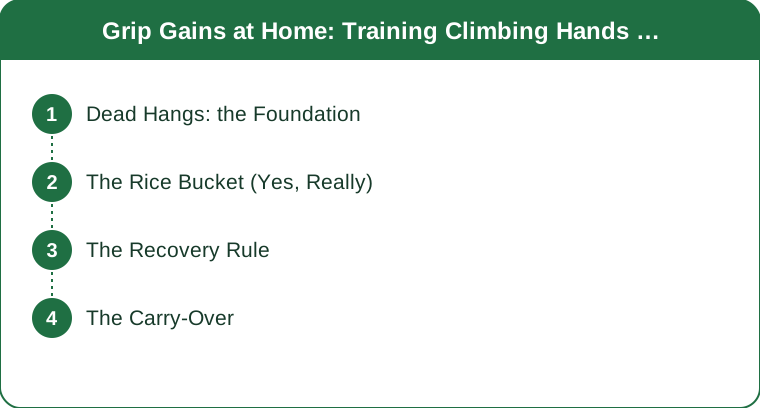
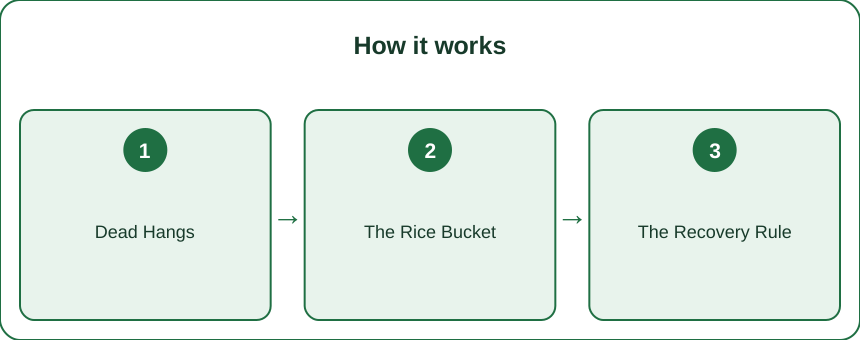
Dead hangs are the foundation, and all you need is a doorway pull-up bar and your own body weight. Hang for 10–20 seconds, rest, and repeat five times, three days a week, keeping your shoulders active rather than letting them slump toward your ears. A few form notes that make a real difference:
- Keep shoulder blades pulled slightly down and back — a passive hang stresses joints more than muscle
- Start with shorter hangs and build duration gradually rather than maxing out on day one
- Grip strength tends to respond fast — noticeable change in weeks, not months, for most beginners
Does the rice-bucket trick actually work?
Yes, and it’s a genuine favorite among climbers for a reason. Plunge your hands into a bucket of dry rice and open, close, twist, and dig for about two minutes. This trains the extensor muscles on the back of your hand and forearm — the ones that open your fingers — which regular gripping exercises tend to neglect entirely. It also happens to be oddly satisfying, which makes it one of the easier home exercises to actually stick with.

How much rest does grip training actually need?
More than most people assume. Finger tendons adapt much more slowly than muscles do, which is exactly why overeager grip training is one of the most common ways new climbers get hurt. A few ground rules worth following:
- Leave at least 48 hours between dedicated grip sessions
- Skip fingerboarding entirely in your first year of climbing — tendons need time to catch up to enthusiasm
- Any sharp, localized finger pain is a stop signal, not a “push through it” signal — see a doctor or physical therapist if pain persists
Does grip training help outside of climbing too?
Absolutely — grip strength shows up far beyond the climbing wall. Farmer carries, towel-grip rows, and even wrestling open a stubborn jar lid all draw on the same muscles you’re building with dead hangs and rice-bucket work. Grip strength is also frequently discussed in general longevity and healthy-aging conversations, which means the climbing hobby is doing some quiet extra work in the background.
5 Mistakes Everyone Makes With Grip Training
- Jumping straight to a hangboard before building a base with simple dead hangs.
- Training grip every single day, ignoring the slower recovery timeline of tendons versus muscles.
- Letting shoulders slump during hangs, turning a grip exercise into a shoulder-joint problem.
- Ignoring finger pain because it “isn’t that bad yet” — tendon injuries build quietly before they announce themselves.
- Only training the closing grip and skipping extensor work like the rice bucket, which creates muscle imbalance.
Mini FAQ
How long does it take to notice grip strength improvements?
Many beginners notice a difference within a few weeks of consistent dead-hang practice, since grip strength tends to respond faster than larger muscle groups.
Is a hangboard necessary for building grip strength?
Not for beginners — a simple doorway pull-up bar covers the basics safely. Hangboards are more useful later, once your tendons have had time to adapt, generally after the first year of consistent climbing.
What should I do if my fingers hurt after grip training?
Stop the exercise and rest — sharp or persistent finger pain is a sign to back off and, if it doesn’t resolve with rest, to check in with a doctor or physical therapist rather than pushing through it.
TL;DR
- Grip fatigues faster than your legs because it rarely gets trained elsewhere.
- Dead hangs (10–20 seconds, 5 reps, 3x/week) are the foundational home exercise.
- The rice bucket trains neglected extensor muscles in about two minutes.
- Finger tendons need 48+ hours of recovery between grip sessions — respect it.
- Grip carries over to farmer carries, daily tasks, and general longevity.
- Stop immediately for sharp finger pain, and check with a professional if it lingers.
Keep Reading
This article is for general informational and styling purposes only. Fit, sizing, and product availability may vary.