Why Your Grip Fails in Humid Weather (and What Actually Fixes It)
Quick Answer: Humidity does not just make your hands sweat more — it stops the sweat evaporating, so friction drops on both your skin and the holds. Chalk alone cannot fix it. Use a drying agent before you start, chalk in thin frequent applications rather than heavy ones, and brush holds far more often than you would in winter.
A route you flashed in March feels impossible in August, on the same wall, with the same shoes.
You have not lost strength in five months. Friction is a physical quantity and the air just changed it — for you and for the rock.
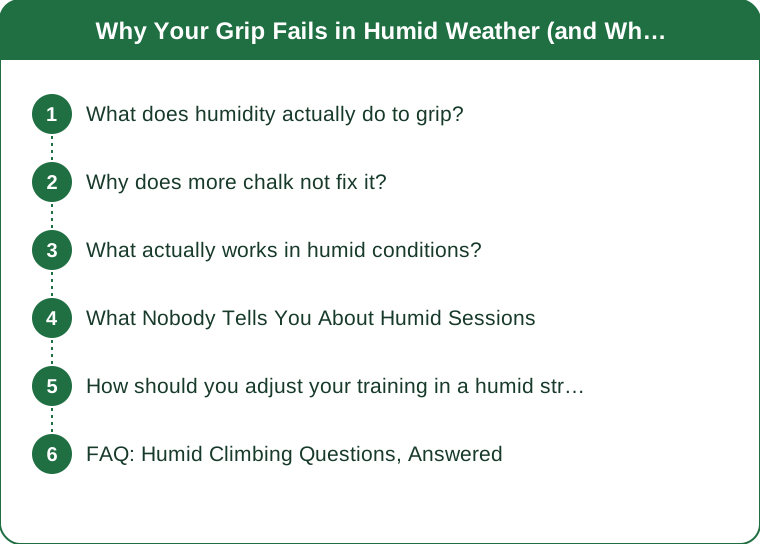
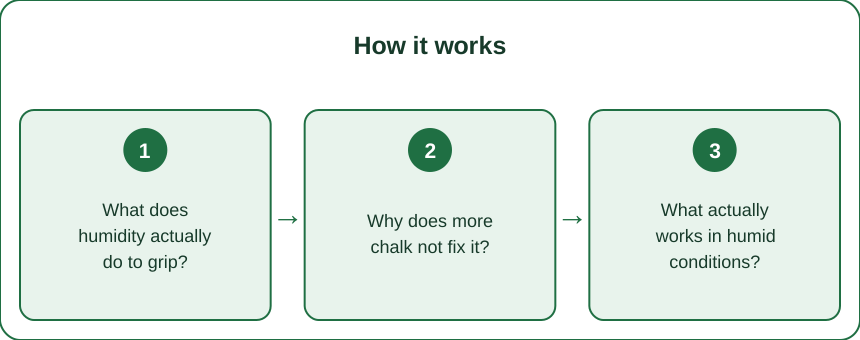
What does humidity actually do to grip?
Two separate things, and most climbers only account for the first.
Your skin stays wet. Sweating is normal and constant; in dry air it evaporates as fast as it appears, leaving skin at a workable moisture level. In humid air the surrounding moisture is already high, so evaporation slows dramatically. The sweat stays on your fingertips, and friction between skin and rock falls sharply.
The holds get wet too. Plastic and rock both accumulate a thin film of moisture from the air, plus everything the previous climber left. Limestone and polished plastic are the worst offenders — a greasy hold in August is genuinely more slippery, not just perceived that way.
The combined effect is why humid sessions feel disproportionately hard. You are climbing at reduced friction on both surfaces simultaneously, which affects your feet as much as your hands even though nobody thinks about shoe rubber this way.
Grading yourself against your dry-day performance in these conditions is not useful information.
Why does more chalk not fix it?
Chalk is a drying agent, not a friction coating. It absorbs moisture from your skin, and once it is saturated it does nothing — it just sits there as a slick layer.
So in high humidity, a thick layer of chalk saturates within a move or two and then becomes part of the problem. That is the counterintuitive part: heavy chalking in humid conditions can be worse than light chalking, because a saturated chalk paste has less friction than damp skin does.
The strategy that works is the opposite of instinct:
- Thin applications, applied often. A light coat before each attempt, not a heavy coat that lasts a session.
- Dry your hands before chalking, on a towel or your pants. Chalk applied to wet hands is spent immediately.
- Brush the chalk residue off holds far more frequently than you would in winter, because saturated chalk builds up on holds too.
A small towel clipped to your harness or bag is one of the highest-value pieces of humid-weather equipment, and almost nobody carries one.
What actually works in humid conditions?
A layered approach, in order of impact:
1. A drying agent before you start. Antihydral or a similar drying cream applied the night before, sparingly, on the fingertips only. Used correctly it meaningfully reduces sweating for a day or two. Used heavily it makes skin brittle and prone to splitting — start with far less than you think, and skip it entirely if your skin is already dry or cracked.
2. Liquid chalk as a base layer. The alcohol dries the skin as it evaporates and leaves a thin bonded chalk layer that resists saturation better than loose chalk. Apply once at the start of a session, then use loose chalk on top as needed.
3. Brush every hold before you use it. Especially on projects and especially on plastic. This is the single biggest improvement available on a humid day and it costs nothing.
4. Rest longer between attempts. Hands need time to dry, and in humid air that takes considerably longer than usual. Doubling your rest interval does more for your grip than anything else on this list.
5. A fan, if you have one. Air movement restores evaporation. Outdoors, a breezy spot outperforms a still shaded one for exactly this reason.
What Nobody Tells You About Humid Sessions
Your feet slip before your hands do. Rubber loses friction on damp holds too, and foot slips are the most common humid-day failure. Wipe your shoe rubber before every attempt — the same towel, one pass each foot.
Skin condition matters more than grip strength in these conditions. Overly soft, over-moisturized skin sweats through and tears; overly dry skin splits. Late summer punishes both extremes, and the climbers who do best in August are the ones managing skin rather than training harder.
Early morning is better than evening, even when it is cooler in the evening. Relative humidity typically drops as the day warms and rises again after sunset. Temperature alone is a poor guide — check dew point instead, which is the number that actually predicts a greasy day.
Indoor gyms get worse as the session goes on. More bodies, more heat, more moisture in an enclosed space. A gym that felt fine at 5 p.m. is meaningfully greasier by 8 p.m. on a busy August evening.
Everyone is affected. If a route feels impossible and someone else floats it, they are climbing in the same air — but skin type varies enormously and some people genuinely sweat far less. It is not a character difference.
How should you adjust your training in a humid stretch?
Stop trying to send at your limit and use the conditions for what they are good at.
Good in humidity: volume on easier grades, footwork drills (bad friction makes precise feet mandatory, which is excellent training), endurance circuits, and strength work off the wall. A humid month is a genuinely good time to build a base.
Bad in humidity: limit bouldering, crimpy projects, and anything where a foot slip means a bad fall. Slick holds plus maximum effort is where finger injuries happen.
This matters for more than performance. Grip that fails unexpectedly under high load is a recognized mechanism for finger pulley injuries, and greasy conditions increase the odds of exactly that kind of sudden slip. If you feel a pop or a sharp pain in a finger, stop climbing and get it assessed — this is general information, not medical advice.
The practical framing: treat a humid stretch as a training block rather than a performance block. Save the project for the first cool dry week in September, when the friction comes back and the same route feels several grades easier.
FAQ: Humid Climbing Questions, Answered
What humidity level actually affects climbing?
Most climbers start noticing above roughly 60 percent relative humidity, and conditions become clearly greasy above 75. Dew point is the better metric — under about 50°F is good, over 60°F is difficult, and outdoor climbers plan around it for this reason.
Is liquid chalk better than loose chalk?
In humidity, generally yes as a base layer, because it bonds to the skin and resists saturation. In dry conditions the difference is much smaller. Using both — liquid first, loose on top — is the common approach for humid sessions.
Does antihydral really work?
It does reduce sweating, and it is widely used for that reason, but it is easy to overuse. Too much produces hard, brittle, split-prone skin that takes weeks to recover. Apply a very small amount to fingertips only, no more than every few days, and stop at the first sign of stiffness.
TL;DR: Humidity lowers friction on your skin and on the holds at the same time.
- Sweat stops evaporating in humid air, and holds pick up a moisture film — you lose grip on both surfaces at once.
- More chalk makes it worse. Saturated chalk is slicker than damp skin. Go thin and frequent.
- Dry hands before chalking, use liquid chalk as a base layer, and carry a towel.
- Brush every hold, and wipe your shoe rubber — feet slip before hands do.
- Double your rest between attempts. It is the highest-value change on the list.
- Train volume and footwork, not limit projects — slick holds plus max effort is how fingers get hurt.
Check the dew point, not the temperature, and save the project for September.
Keep Reading
This article is for general informational and styling purposes only. Fit, sizing, and product availability may vary.