How Many Rest Days Does Climbing Actually Need Between Sessions?
Quick Answer: Climbing-specific finger and tendon recovery generally needs 48-72 hours between hard sessions, longer than general muscle soreness would suggest, because tendons and pulleys heal on a slower timeline than muscle tissue — climbing on inadequately recovered fingers is one of the most common causes of overuse injury in the sport.
Your muscles feel fine the day after a hard climbing session, so you head back to the gym. Your fingers and tendons, working on a slower recovery clock, may not actually be ready yet.
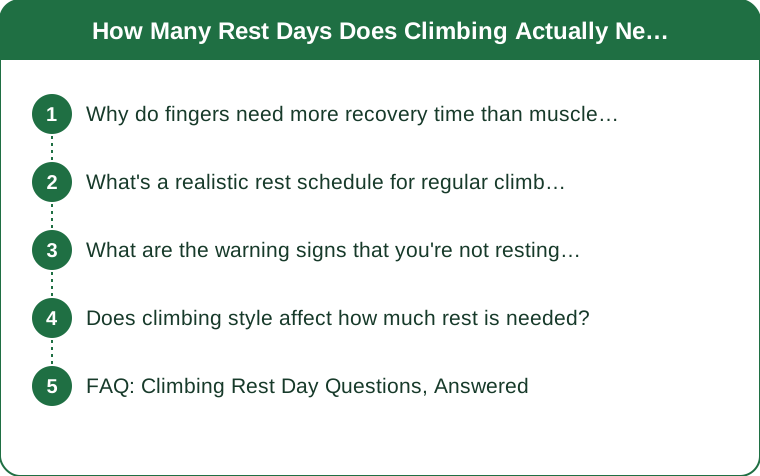
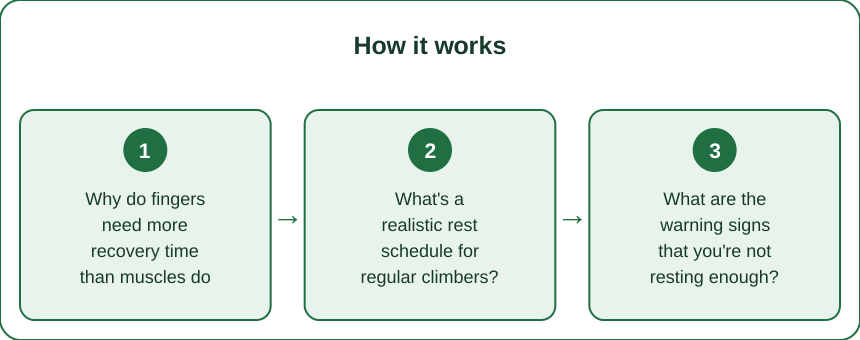
Why do fingers need more recovery time than muscles do after climbing?
Tendons and the finger pulleys climbing relies on heavily have significantly less blood supply than muscle tissue, which means they repair and adapt more slowly. Muscle soreness fading doesn’t mean tendon recovery has caught up — the two systems are genuinely on different timelines.
What’s a realistic rest schedule for regular climbers?
48-72 hours between hard sessions is a commonly recommended range for climbers training at a challenging intensity, with beginners often needing the longer end of that range while their tendons are still adapting to load they haven’t experienced before.

What are the warning signs that you’re not resting enough?
Persistent, specific finger joint or pulley discomfort that doesn’t fully resolve between sessions — as opposed to general muscle fatigue that clears within a day — is the key warning sign that tendon recovery is lagging behind your training frequency.
Does climbing style affect how much rest is needed?
Yes — bouldering and finger-intensive crimping place more acute stress on tendons than longer, lower-intensity route climbing, meaning a heavy bouldering session may need more recovery time than an easier-graded endurance session, even if the two feel similarly tiring in the moment.
FAQ: Climbing Rest Day Questions, Answered
Can I climb every day if the sessions are easy?
Lower-intensity sessions place less acute stress on tendons, so more frequent easy climbing is more sustainable than frequent hard sessions — but persistent joint discomfort is a signal to rest regardless of intensity.
Does taking more rest days actually slow progress?
No — under-recovered tendons are a common cause of injuries that force much longer breaks, so adequate rest tends to support faster long-term progress than pushing through inadequate recovery.
Is cross-training on rest days okay?
Generally yes, as long as it doesn’t heavily load the fingers and forearms — lower-body or cardio work on rest days doesn’t interfere with tendon recovery the way another climbing session would.
TL;DR:
- Tendons and finger pulleys recover more slowly than muscle soreness suggests
- 48-72 hours between hard sessions is a reasonable general guideline
- Persistent specific joint or pulley discomfort is the key warning sign of under-recovery
- Bouldering and crimp-heavy sessions typically need more rest than lower-intensity route climbing
This is general information, not medical advice — persistent finger pain is worth having evaluated rather than climbing through it.
Keep Reading
This article is for general informational and styling purposes only. Fit, sizing, and product availability may vary.