Why Climbing Grades Stall - and the Thing That Actually Breaks the Plateau
Quick Answer: Most climbers plateau because they keep climbing the same way harder rather than climbing differently. At the intermediate grades, footwork, hip positioning and route reading limit progress far more than finger strength does - and hangboarding before you have the technique base is the most common way to get injured instead of better. The fastest way through a plateau is usually deliberate volume on easier routes with a specific technical focus.
You have been at the same grade for four months and you have started to suspect it is permanent.

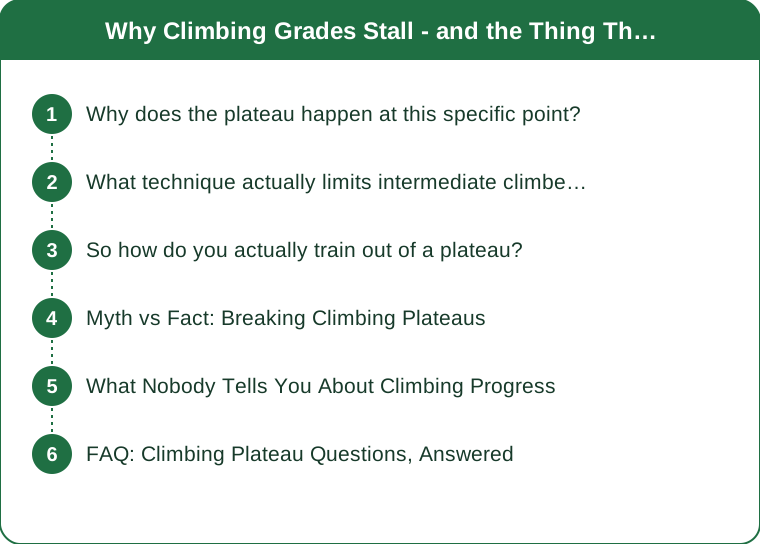
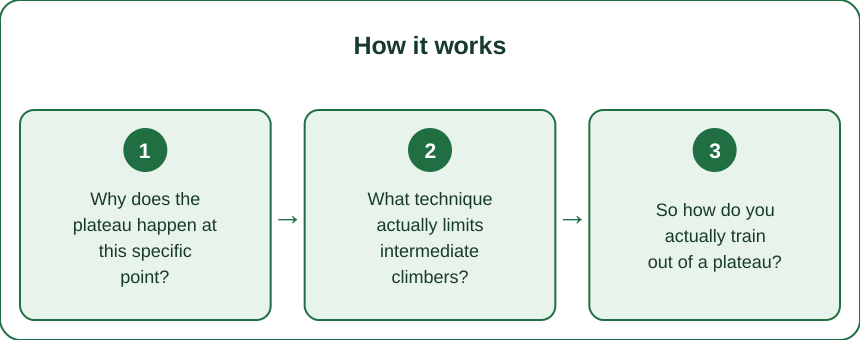
Why does the plateau happen at this specific point?
Because the thing that got you here stops working, and that transition is predictable.
Early progress comes from general adaptation. Beginners improve rapidly because everything is untrained - grip, body awareness, movement patterns, confidence. Almost any climbing produces improvement.
At the intermediate grades, that runs out. Routes stop rewarding effort and start rewarding precision. The holds get worse, so body position determines whether you can use them at all, and the same brute-force approach that worked at easier grades simply fails.
And here is the trap: it feels like a strength problem. You fall off because you cannot hold on, so you conclude you need stronger fingers. But you often could not hold on because your hips were far from the wall, your weight was on your arms instead of your feet, and you were gripping harder than the hold required.
The diagnostic question: watch a stronger climber do a route you failed. If they look like they are doing something structurally different rather than pulling harder, it is technique. They almost always are.
This is also why the plateau feels sudden. Nothing changed in your training. The requirements of the routes changed, and the response has to change with them.
What technique actually limits intermediate climbers?
Four things, in order of how much they hold people back.
1. Footwork precision. The single largest limiter and the most commonly ignored. Most intermediate climbers place feet approximately, adjust after weighting, and look away before the foot lands. Precise placement - look at the foothold until your foot is on it, and do not readjust - transforms what holds become usable.
A useful drill: silent feet. Climb an easy route with no sound from your feet. It is nearly impossible to be imprecise and silent at the same time.
2. Hips close to the wall. Weight over your feet rather than hanging from your arms. Hips away from the wall is why your forearms burn on routes that should not be hard, and it is the most common cause of pumping out.
3. Straight arms whenever possible. Hanging on straight arms uses skeletal structure; hanging bent uses muscle. Bent-arm climbing is a stamina leak that runs continuously.
4. Route reading before you start. Intermediate climbers typically start climbing and figure it out en route, which means discovering a wrong sequence while already tired on the hold. Reading from the ground - where the rests are, which hand goes where, where it gets hard - is free and it is what better climbers spend their time on.
A fifth, related to all of them: turning your hip in. Getting a hip against the wall extends reach considerably and takes load off the arms. Climbing square-on to the wall is a beginner pattern that persists long past when it should.
So how do you actually train out of a plateau?
A structure that prioritises the actual limiter.
1. Volume on easier routes with one technical focus. Two or three grades below your max, for quantity, with a single thing to work on each session. Silent feet one session, straight arms the next, hip turns the next. This is the highest-return training for intermediate climbers and the least popular, because it does not feel like progress.
2. Project routes above your grade, deliberately. Not to send them - to expose you to movements you do not currently have. Two or three sessions a week where you spend real time on things that are too hard for you.
3. Climb with people better than you, and watch them. Observational learning is genuinely effective in movement skills, and it is free. Ask how they did a section rather than only whether they did.
4. Vary the wall angle and style. Most plateaus are partly a specialisation artifact - people climb what they are good at. If you avoid slabs, overhangs, or crimps, that avoidance is defining your ceiling.
5. Add strength work, in the right order. General pulling strength and core first - rows, pull-ups, hanging leg raises. Fingerboarding after you have at least a year or two of consistent climbing, and even then with a structured protocol. Finger injuries are the most common climbing injury and the tendons adapt more slowly than the muscles pulling on them.
6. Rest properly. Three climbing sessions a week with rest days between produces better progress than five, particularly for connective tissue that is already the limiting structure.

Myth vs Fact: Breaking Climbing Plateaus
Myth: You need stronger fingers to climb harder. Fact: Eventually yes, and at intermediate grades technique is typically the larger limiter by a wide margin. Training fingers before technique is how climbers get pulley injuries instead of grades.
Myth: Climbing more often is the answer. Fact: Beyond three to four sessions a week, most people accumulate fatigue faster than adaptation, particularly in tendons. Quality and variety beat frequency at this stage.
Myth: Losing weight is the fastest route to harder grades. Fact: Strength-to-weight matters and pursuing weight loss is associated with real risks in climbing, including disordered eating and reduced bone density. Getting stronger and more efficient is the sustainable version of the same goal.
Myth: Easy climbing is wasted time. Fact: Volume on easy terrain is where movement patterns become automatic. You cannot learn technique on routes that are at your limit, because at your limit you revert to whatever you already do.
Myth: Hangboarding is for advanced climbers only, so never touch it. Fact: A structured protocol has value once you have a solid base of climbing years behind you. The problem is doing it early, unstructured, or instead of climbing - not the tool itself.
Myth: If you have not progressed in three months you have hit your ceiling. Fact: Intermediate plateaus commonly last months and break when the training approach changes. The ceiling most people hit is the ceiling of what their current approach can produce, not their potential.
What Nobody Tells You About Climbing Progress
Grades are inconsistent between gyms and setters, and comparing across them is noise. A plateau measured by grade may partly reflect a change in setting style rather than your climbing. Track how routes feel and what movements you can do instead.
Fear is a physical limiter, not just a mental one. Hesitation causes over-gripping, delayed commitment, and inefficient movement, all of which cost real energy. Falling practice - deliberate, controlled, in a safe setting - improves climbing performance for many people more than any strength work, and it is the most avoided training there is.
Skin is a genuine limiting factor and nobody plans for it. Sessions end because of skin far more often than climbers admit. Filing calluses, moisturising on rest days, and stopping before skin tears extends your usable training time meaningfully.
Progress at intermediate grades is not linear and the steps are large. The jump between grades widens considerably as you go up - months at a grade is normal, not a stall.
Antagonist training is preventive, not optional. Climbing is overwhelmingly a pulling sport. Push-ups, shoulder work, and finger extension work reduce the elbow and shoulder problems that end intermediate climbers’ seasons. Ten minutes twice a week.
And the most common single fix: you are probably gripping every hold much harder than it requires. Deliberately trying to use the minimum grip that works, on easy routes, is startling the first time - and it is where a large amount of your endurance is going.
FAQ: Climbing Plateau Questions, Answered
How long do plateaus normally last?
Months is entirely normal at intermediate grades, and they typically break when something about the approach changes rather than when you simply persist longer.
Should I start hangboarding?
Generally not until you have a year or two of consistent climbing and no current finger pain, and then only with a structured protocol. Technique work returns more at intermediate grades and carries far less injury risk.
How many days a week should I climb?
Three is a good target for most intermediate climbers, with rest days between. More than four regularly tends to accumulate tendon fatigue faster than it produces improvement.
Is bouldering or rope climbing better for improving?
Bouldering builds power and movement skill; rope climbing builds endurance and head game. Doing both is the most reliable way to avoid the specialisation that creates plateaus.
What do I do about finger pain?
Stop climbing on it. Finger pain, particularly a popping sensation or pain at the base of a finger, needs rest and assessment - climbing through it is how a minor pulley strain becomes a long injury. Get persistent pain looked at professionally.
TL;DR:
- Intermediate plateaus are usually technique limits misread as strength limits
- Footwork precision, hips close to the wall, straight arms, and reading routes from the ground
- Volume on easy routes with one technical focus per session is the highest-return training
- Train fingers after a year or two of climbing, with structure - tendons adapt slower than muscles
- Falling practice, antagonist work, and skin management are the three most avoided fixes
You are probably gripping every hold twice as hard as it needs. Start there.
Keep Reading
This article is for general informational and styling purposes only. Fit, sizing, and product availability may vary.