Why Your Climbing Warm-Up Is Too Short, and What to Add
Quick Answer: Finger tendons and pulleys need progressive loading, not general cardio, and they warm up more slowly than muscle. A proper climbing warm-up runs 12 to 15 minutes in three stages: 4 minutes raising core temperature, 4 minutes of shoulder and finger-specific preparation, then 5 minutes of climbing that gradually increases grip intensity. Skipping the middle stage is why finger injuries cluster in the first 20 minutes of a session.
The two-easy-problems approach warms your legs and your enthusiasm. It does very little for the tissue that actually gets hurt.
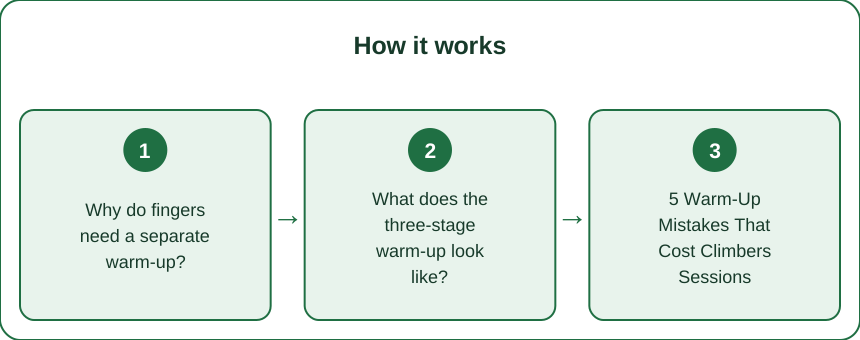
Why do fingers need a separate warm-up?
Because tendons and pulleys have a poor blood supply compared to muscle, so they warm and adapt more slowly.
Muscle temperature rises quickly with general activity - a few minutes of movement does most of the job. Tendon and connective tissue relies far more on local loading to increase compliance and fluid movement within the tissue.
The practical consequence: after 5 minutes of jogging in place, your forearm muscles are ready and your A2 pulleys are not. Then you pull hard on a small crimp and the load goes exactly where the preparation did not.
Injury timing data from climbing supports this. Pulley injuries disproportionately occur early in sessions and on the first hard attempt of the day, which is precisely the profile you would expect if fingers were being loaded before they were prepared.
What does the three-stage warm-up look like?
Stage 1 - General, 4 minutes. Anything that raises core temperature and gets blood moving. Light cardio, easy traversing on big holds, or 3 minutes of brisk walking plus arm swings. You want to be slightly warm, not breathing hard.
Stage 2 - Specific, 4 minutes. This is the stage everyone skips.
- Shoulder circles and band pull-aparts, 2 sets of 15
- Scapular pull-ups on a bar or jug, 2 sets of 8 - hang with straight arms and pull your shoulders down without bending your elbows
- Wrist circles and forearm stretches, 30 seconds each direction
- Finger extensions against a rubber band, 2 sets of 15
- Open-hand hangs on a large hold, 3 hangs of 10 seconds with feet supporting most of your weight
Stage 3 - Climbing, 5 minutes. Three to four problems or routes, each one grade harder than the last, ending about three grades below your project level. Focus on big open holds first, small crimps last.
Total: about 13 minutes. It will feel like a lot the first few times and then it will feel obvious.
5 Warm-Up Mistakes That Cost Climbers Sessions
- Going straight to crimps. Open-hand and jug holds first, always. Crimping is the highest-stress grip position and it belongs at the end of the warm-up, not the start.
- Static stretching before climbing. Long-hold stretching before power work has been shown to temporarily reduce force output. Save it for after.
- Warming up only what you plan to use. Antagonist work - finger extensors, external rotators - takes 2 minutes and is the main protection against the imbalances climbing creates.
- Skipping the warm-up on outdoor days. Outdoor sessions are the worst offenders because there is no easy warm-up route at the crag. Bring a band and do stage 2 in the car park.
- Warming up once for a 3-hour session. After a 30-minute belay break or a long rest, you are partly cold again. Re-do a short version of stage 3.
The third one is the difference between climbing at 45 and not climbing at 45.
Does the warm-up change with the weather?
Substantially, and this is the season it starts to matter again.
Cold tissue is stiffer and less compliant. Every degree the ambient temperature drops means longer to reach working tissue temperature - and outdoor climbing season is arriving exactly as temperatures fall, which is a genuinely bad combination for fingers.
In conditions below about 55F, extend stage 1 to 6 to 8 minutes and add gloves between attempts. Keeping hands warm between burns matters as much as the initial warm-up.
There is a tension here worth naming. Cold, dry conditions produce the best friction, which is exactly why people climb hard outdoors in fall - and cold tissue is exactly when fingers are most vulnerable. The friction improvement tempts you onto harder moves in worse tissue conditions.
The answer is not to avoid good conditions. It is to warm up longer specifically because the conditions are good.
How do I know if the warm-up worked?
Three checks, all quick.
Grip feels the same on both hands. Asymmetry at the start of a session is a reliable signal that one side needs more preparation, often the non-dominant one.
No sharp sensation on a moderate crimp. Dull tightness that eases with movement is normal. A specific point of sharpness in a finger is a stop signal, not a push-through signal.
Your third warm-up problem feels easier than your first. If it does not, you are still cold and adding difficulty is the wrong move.
One useful habit: keep a note of how long your warm-up took and how the session went, for two weeks. Most climbers discover that their best sessions correlate with the longest warm-ups, and that their tweaks happened on the days they were in a hurry.
Any popping sensation in a finger during a pull is worth stopping the session for and getting assessed. This is general information, not medical advice.
FAQ: Climbing Warm-Up Questions, Answered
Should I use a hangboard to warm up?
Only with feet supporting weight and on large edges. A hangboard is excellent for controlled progressive loading and terrible if you go straight to full bodyweight on a 20mm edge.
How long before a project attempt should I finish warming up?
Aim to start your hard attempt within about 10 minutes of finishing. Longer than 20 minutes of rest and you have partly cooled down again.
Is a warm-up different for bouldering versus routes?
Bouldering needs more emphasis on maximal grip preparation because the intensity arrives immediately. Route climbing benefits from a slightly longer general stage for aerobic readiness. The finger work is the same for both.
TL;DR:
- Fingers warm up more slowly than muscle because tendons and pulleys have limited blood supply.
- Use three stages over 12 to 15 minutes: general, specific, then climbing that builds grip intensity.
- Stage 2 is the one everyone skips - scapular pulls, band work, finger extensions, supported open hangs.
- Open-hand holds first, crimps last. Skip static stretching until after you climb.
- Cold weather means a longer stage 1, gloves between burns, and more discipline exactly when conditions tempt you.
Outdoor season is starting and the friction is about to get very good. Give your fingers the extra five minutes before you take advantage of it. This is general information, not medical advice.
Keep Reading
This article is for general informational and styling purposes only. Fit, sizing, and product availability may vary.