Why Your Fingers Hurt the Day After Climbing - and Which Kind of Sore Is a Warning
Quick Answer: Generalised achy stiffness across both hands the morning after climbing is common and usually reflects normal tissue loading. Sharp, localised pain at a single finger joint, pain that worsens with specific grips, swelling at one joint, or any popping sensation during a climb are different - those point toward tendon, pulley, or joint problems that need rest and assessment. Tendons and pulleys adapt far more slowly than muscles, which is why finger injuries are the most common way climbing progress stops.
The difference between soreness and damage is location and character. Diffuse and both hands is usually fine. Sharp and one spot is not.
This is general information rather than medical advice.

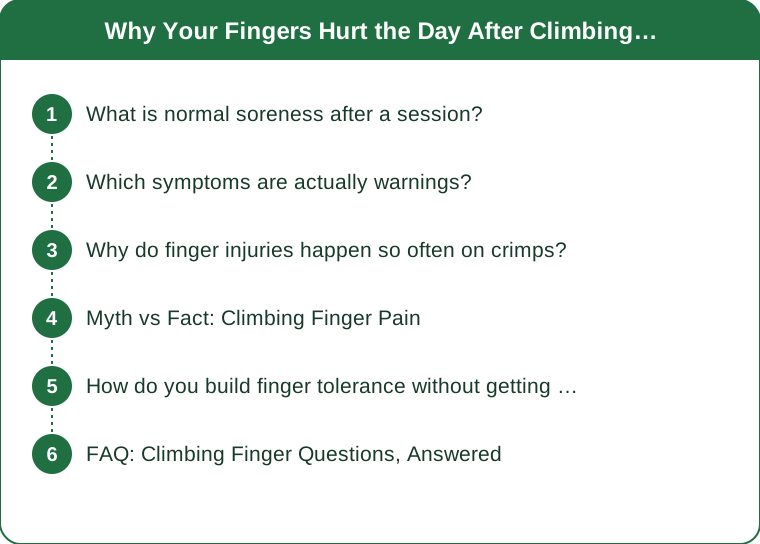
What is normal soreness after a session?
Diffuse, symmetrical, and gone within a couple of days.
What normal looks like:
- Generalised ache across the fingers and forearms, not localised to one joint
- Stiffness in the morning that eases within about 15 minutes of moving
- Both hands affected to a broadly similar degree
- Improving day by day, and gone within 48 to 72 hours
- Sore to press across a broad area rather than one specific point
Why fingers get sore at all. Climbing loads the finger flexor tendons and the pulley system that holds them against the bone in a way almost nothing else does. The connective tissue involved has limited blood supply and adapts substantially more slowly than muscle - a common estimate is that tendons and pulleys take considerably longer to strengthen than the muscles pulling on them.
Which produces the central problem in climbing. Your muscles get strong quickly, so you can pull harder than your connective tissue is ready for. The gap between muscular capacity and tendon readiness is where nearly every finger injury lives, and it is widest in the first year or two, and again after any return from a break.
Skin soreness is separate and usually obvious - raw fingertips, tender pads, and split skin at the tips. Unpleasant, self-limiting, and unrelated to tendon health, though it does affect how you grip and can push you into worse positions.
Which symptoms are actually warnings?
Six, and they are all specific rather than general.
1. Sharp, localised pain at one finger joint. Particularly at the base or middle joint, and particularly when you can point to the exact spot with one finger. This is the most important single signal on the list.
2. A pop, click, or snap during a move, usually on a crimp. A pop with subsequent pain and swelling is the classic presentation of a pulley injury and needs assessment. Stop climbing that day.
3. Swelling at a single joint that persists overnight. Generalised puffy hands after a hard session is common; one swollen joint is not.
4. Pain that is worse in a specific grip position. If half crimp hurts and open hand does not, that pattern points to a specific structure rather than general fatigue.
5. Pain that has lasted more than a week, or that returns immediately at the same intensity each session. Normal soreness fades within days and reduces as you adapt.
6. Bowstringing - the tendon visibly lifting away from the finger when you curl it under load. Uncommon, and a sign of significant pulley damage that needs prompt medical assessment.
What to do if any of these apply: stop climbing on it, rather than reducing intensity. Finger injuries are the injuries climbers most consistently try to train through, and the ones where doing so most reliably converts a few weeks off into several months.
Who to see: a physiotherapist or sports doctor with climbing experience if possible. Climbing finger injuries are specific enough that familiarity genuinely matters, and many climbing gyms can recommend someone.
Why do finger injuries happen so often on crimps?
Because the crimp position multiplies the force on the pulley system.
The mechanics. In a full crimp - fingers bent sharply at the middle joint with the thumb over the index finger - the tendons pull at a much sharper angle across the pulleys that hold them to the bone. The force on the A2 pulley in particular can be substantially higher than the force being applied at the fingertip. Open-hand and half-crimp positions produce lower pulley loads.
Which is why the standard advice exists: train and warm up in open hand and half crimp, and use full crimp sparingly and deliberately rather than as a default. Full crimping is not forbidden - it is a tool with a higher cost.
The situations where injuries cluster:
- Cold fingers. Almost every experienced climber has a story here. Tissue is stiffer and less tolerant when cold, and the first hard move of the session on cold fingers is high risk
- The foot slip. A foot popping off transfers your whole body weight suddenly onto whichever fingers are on the hold. This is the single most common mechanism for acute pulley injury
- Small pockets, particularly two-finger and mono pockets, which concentrate load on very few structures
- The last problem of the session, when you are tired, your technique has degraded, and you are pulling harder to compensate
- The first weeks back after a break, when strength returns faster than tissue tolerance
A practical warm-up that reduces risk substantially: ten minutes of general movement to raise your temperature, then 15 to 20 minutes of progressively harder easy climbing on large holds, then the hard climbing. Most climbers warm up their muscles and not their fingers, and the finger-specific portion is what matters here.

Myth vs Fact: Climbing Finger Pain
Myth: Sore fingers mean you had a good session. Fact: Diffuse mild soreness is normal. Localised joint pain is a warning, and the habit of treating all finger pain as a badge is why so many climbers have a chronic finger.
Myth: If you can still climb on it, it is fine. Fact: Most pulley injuries allow continued climbing at reduced intensity, which is exactly why they get worse. Ability to climb is a poor test.
Myth: Taping prevents finger injuries. Fact: The evidence that standard taping meaningfully reduces load on a healthy pulley is weak. Taping has a role in supporting a healing injury and as feedback, and it is not preventive armour.
Myth: You should stretch your fingers more. Fact: Finger flexibility is rarely the limiting factor. Gradual load progression is what builds tolerance. Warming up thoroughly matters; stretching your fingers does not do much.
Myth: Hangboarding causes finger injuries. Fact: Hangboarding done progressively is one of the better ways to build tendon tolerance, because the load is controlled and measurable. Injuries come from doing it too soon, too hard, or without warming up - and from climbing itself far more often than from structured hangboarding.
Myth: Rest means doing nothing. Fact: For most finger complaints, complete inactivity is not the goal. Reduced load, avoiding the aggravating grip, and gentle controlled loading under guidance is usually better - which is a good reason to see a physiotherapist rather than guess.
How do you build finger tolerance without getting hurt?
Slowly, deliberately, and by controlling volume rather than intensity.
The principles that matter most:
Cap your climbing frequency early on. Two to three sessions a week with rest days between is a reasonable pattern for the first year or two. Consecutive days of hard climbing is the pattern most associated with overuse finger problems in newer climbers, whose enthusiasm outpaces their tendons.
Progress volume before intensity. More time on easier problems builds tissue tolerance with far less risk than a few attempts at a much harder grade.
Warm up the fingers specifically, as described above. Fifteen to twenty minutes of progressive easy climbing before anything hard.
Vary the grip. Sessions spent entirely on small crimps concentrate load on the same structures. Mixing slopers, pinches, jugs, and open-hand holds distributes it.
Stop when technique degrades. The last two problems of a long session, attempted with tired forearms and sloppy feet, deliver most of the injury risk and very little of the training benefit.
Introduce hangboarding carefully, if at all, after a year or so of climbing - and then with a structured protocol, thorough warm-up, and conservative loading. It is a good tool used at the right time and a reliable injury source used too early.
On returning after a finger injury: the return is where reinjury happens. Progress by weeks rather than sessions, avoid crimping and pockets initially, and expect the tissue to lag behind how good it feels. A finger that feels fine at rest is not the same as a finger ready for a foot slip on a small crimp.
On general hand health: climbers frequently develop imbalances from constant gripping. Simple finger extension work with a rubber band, and forearm extensor strengthening, are cheap, quick, and widely recommended for elbow and hand health.
Any finger pain that is sharp, localised, swelling, or persistent past a week is worth having assessed rather than trained around. This is general information, not medical advice.
FAQ: Climbing Finger Questions, Answered
Is it normal for my fingers to hurt after climbing?
Diffuse ache and morning stiffness across both hands that resolves in a day or two is common. Sharp pain at one joint is not, and should be treated differently.
How do I tell a pulley injury from normal soreness?
Pulley injuries are typically sharp, localised at one finger, often follow a pop or a foot slip, and are worse in crimp positions. Normal soreness is diffuse and symmetrical.
How long do finger injuries take to heal?
It varies enormously with severity - from a few weeks for a minor strain to several months for a significant pulley injury. Getting it assessed early makes a real difference to that range.
Should I tape my fingers to prevent injury?
The evidence for standard taping preventing injury in healthy fingers is weak. Taping is more useful supporting a healing injury than as prevention.
How often should a beginner climb?
Two to three sessions a week with rest days between, for the first year or two. Tendons adapt much more slowly than muscles, and consecutive hard days is the classic overuse pattern.
TL;DR:
- Diffuse ache across both hands that fades in a day or two is normal adaptation
- Sharp localised joint pain, a pop during a move, single-joint swelling, or grip-specific pain are warnings
- Tendons and pulleys adapt far more slowly than muscles, which is where nearly every finger injury lives
- Full crimping, cold fingers, foot slips, and the last problem of a tired session are the risk clusters
- Two to three sessions a week with rest days, progressive volume, and a proper finger warm-up prevent most of it
If you can point to the pain with one finger, stop climbing on it and get it looked at. That single rule prevents most months-long layoffs.
Keep Reading
This article is for general informational and styling purposes only. Fit, sizing, and product availability may vary.