Why Your Grip Fails Before Your Arms Do and What to Train
Quick Answer: Grip fails first because forearm flexors are small muscles working near-continuously while your larger muscles work intermittently, and the sustained contraction restricts their own blood flow - which is what a pump actually is. The fix for most climbers is endurance and recovery capacity, not maximum grip strength: more time on easier holds, deliberate rest between attempts, and technique that shifts load to your feet.
Your arms feel fine. Your back feels fine. And yet your hands are simply opening off the wall. That mismatch is not a weakness you have failed to notice - it is how forearms work under sustained load.
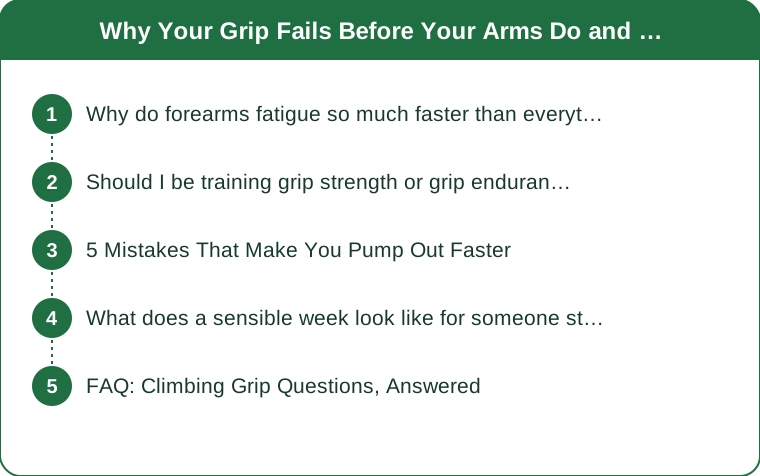
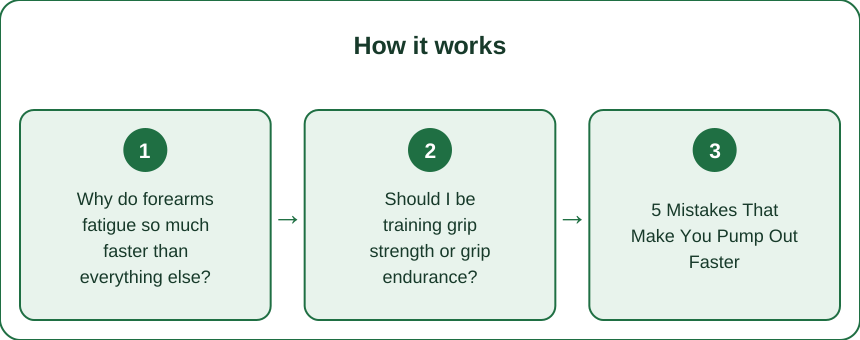
Why do forearms fatigue so much faster than everything else?
Because of what they are being asked to do, and because of what that does to their own blood supply.
Sustained contraction restricts circulation. When a muscle contracts above roughly 40-50% of its maximum, the pressure inside it compresses its own capillaries and impedes blood flow. Gripping a hold is exactly that kind of contraction, held for the length of a move or a rest position. The muscle is working hard while progressively cutting off its own oxygen and waste removal.
That is the pump. The swollen, burning, hand-will-not-close feeling is metabolic byproduct accumulation combined with fluid shift in a muscle that cannot flush itself while it is working.
The muscles involved are small. Forearm flexors have limited total capacity compared to your lats and biceps, so the same absolute demand represents a much higher percentage of their maximum.
They almost never get a break. Your legs get a rest every time you stand on a good foothold. Your back gets a rest between pulls. Your grip is loaded during the move, during the setup, and during the so-called rest position. Over a route, forearm work time is a far larger share of the total than anything else.
So failure order is not about which muscle is weakest. It is about which one is working most continuously with the worst circulation.
Should I be training grip strength or grip endurance?
For almost everyone below advanced level: endurance and recovery, by a wide margin.
Here is the distinguishing test. If you fall off because you cannot hold a specific small hold at all, even fresh at the start of a session, that is a strength limitation. If you can hold everything on the route fresh but your hands open after thirty seconds of climbing, that is an endurance and recovery limitation. The second is far more common, and the two are trained differently.
Endurance training means accumulating time on holds you can comfortably use - climbing routes several grades below your limit, doing long traverses, doing more total climbing per session at lower intensity. The goal is capillary density and the ability to clear metabolites, which is trained by volume rather than by maximum effort.
Recovery capacity is trainable and undertrained. Practice shaking out, resting in good positions, and deliberately recovering mid-route rather than rushing. Many climbers can recover far more than they attempt to, because they have never practiced it.
Maximum grip strength work - hangboarding in particular - is genuinely effective and it is also where beginners get hurt. Finger tendons and pulleys adapt considerably more slowly than muscle, so a beginner whose muscles can handle hangboard loads may have connective tissue that cannot. The usual guidance is at least one to two years of consistent climbing before structured hangboarding, and that guidance exists because of a well-known injury pattern.
5 Mistakes That Make You Pump Out Faster
1. Overgripping. Most climbers hold every hold as though it were the worst hold on the route. Consciously testing how lightly you can hold a jug, and then using that, saves an enormous amount of forearm work over a session. This is the single largest and cheapest improvement available to most people.
2. Straight-arm neglect. Hanging with bent arms loads your biceps and forearms continuously. Hanging with straight arms shifts load onto your skeleton and connective tissue at almost no metabolic cost. Straight arms whenever you are not actively pulling is the most efficient habit in climbing.
3. Ignoring your feet. Every kilogram of weight your feet support is a kilogram your hands do not. Poor footwork does not just look untidy - it directly transfers load to the tissue that fails first. Precise foot placement is grip training in disguise.
4. Too little rest between attempts. Forearms need considerably longer to recover than large muscles - often 3-5 minutes for a hard attempt. Climbers routinely take one or two, then wonder why their second attempt is worse. Cumulative under-recovery over a session is why the last hour feels pointless.
5. Climbing only at your limit. A session made entirely of hard attempts produces very little total time on the wall, which is the opposite of what builds endurance. A useful ratio for most sessions is roughly 70% at moderate grades and 30% at or near your limit.
What does a sensible week look like for someone stuck here?
Structure it around time on the wall, with recovery treated as part of the plan.
Two to three climbing sessions per week, with at least one full day between them. Finger and forearm tissue recovers more slowly than you feel, and consecutive hard days are the most reliable route to an overuse injury.
Structure a typical session:
- 15 minutes warming up - easy climbing, gradually increasing difficulty. Never start on hard holds with cold fingers; this is where a large share of finger injuries happen.
- 20-30 minutes of technique or limit work while you are fresh, with 3-5 minutes rest between real attempts.
- 20-30 minutes of volume on easier terrain - continuous climbing, traverses, and downclimbing. Downclimbing in particular doubles your time on the wall for free and builds control.
- 5-10 minutes of easy movement and gentle forearm stretching afterward.
Add one dedicated endurance session if you have a third day: sustained easy climbing with short rests, aiming for a mild pump you can maintain rather than a maximum one.
Track something crude. Total minutes on the wall, or number of routes completed, rather than grades. Endurance progress shows up as more climbing at the same grade well before it shows up as a higher grade, and if you only track grades it looks like nothing is happening for weeks.
FAQ: Climbing Grip Questions, Answered
How long does it take to see grip endurance improve?
Noticeable improvement in how long you can climb before pumping out typically shows within four to six weeks of consistent volume-focused sessions. Maximum finger strength adapts much more slowly - months rather than weeks - and connective tissue slower still, which is the underlying reason for patience with hangboarding.
Are my forearms supposed to be sore the next day?
Mild general soreness after a big session is normal. Sharp or localized pain in a finger, particularly at a joint or accompanied by a popping sensation, is not - that pattern is associated with pulley injuries and it is a stop-and-get-it-assessed situation rather than a train-through one. Persistent elbow pain also warrants attention, since it is common in climbers and easier to address early. This is general information, not medical advice.
Does hand strength training away from the wall help?
Grip trainers and stress balls train a different pattern than climbing and transfer poorly. What does help off the wall is antagonist work - finger extensions with a rubber band, light wrist and forearm extension work - which addresses the muscular imbalance that climbing creates and is associated with fewer elbow problems. Ten minutes twice a week is enough.
TL;DR:
- Grip fails first because sustained contraction restricts its own blood flow and forearms almost never rest.
- Most climbers need endurance and recovery, not maximum strength - test which by whether you fail fresh or fail late.
- Fix overgripping, hang with straight arms, use your feet, rest 3-5 minutes between hard attempts.
- Aim for roughly 70% moderate volume, add downclimbing, and delay structured hangboarding until you have a year or two of climbing.
The pump is not a signal that you need stronger fingers. It is a circulation problem inside a small muscle that is working continuously while everything else takes breaks. Grip more lightly, stand on your feet, and spend more minutes on easier terrain - and the forearms that used to quit at thirty seconds start lasting through the route.
Keep Reading
This article is for general informational and styling purposes only. Fit, sizing, and product availability may vary.