Why Your Second Climbing Session of the Week Always Feels Worse
Quick Answer: Connective tissue - tendons, pulleys, and joint capsules in the fingers - recovers considerably more slowly than muscle, and grip strength is the first thing to drop when it is under-recovered. Give at least 48 hours between hard finger-intensive sessions, make the second session of the week volume and technique rather than limit bouldering, and treat two bad sessions in a row as a signal to add a rest day.
Monday you were climbing well. Wednesday the same problems feel like someone added a grade overnight, your fingers open on holds you held easily, and you leave wondering whether you have got worse in 48 hours. You have not. You are climbing on tissue that has not finished repairing.

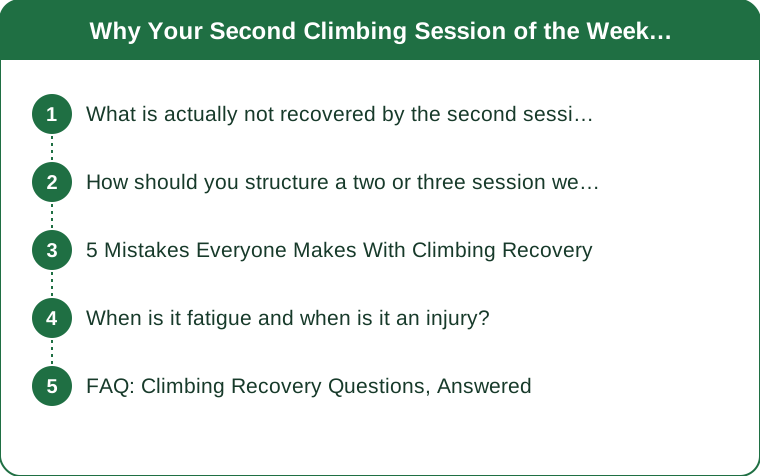
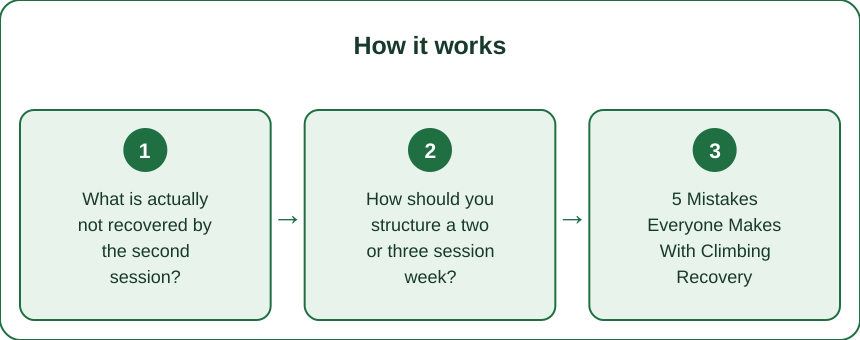
What is actually not recovered by the second session?
Not your muscles, mostly. Muscle recovers relatively quickly from a climbing session - typically 24 to 48 hours for the forearm flexors after a moderate load. Three other things take longer.
Connective tissue. Tendons and the annular pulleys that hold them against the finger bones have far poorer blood supply than muscle and remodel much more slowly - a process measured in days to weeks rather than hours. Climbing, especially crimping, loads these structures heavily. They are frequently the limiting factor in how often you can climb hard, and they give almost no warning before they become a problem.
Skin. Overlooked and genuinely limiting. Tips that are thin, tender, or have a flapper reduce how hard you can pull long before your muscles run out. Skin takes two to three days to rebuild after a heavy session.
The nervous system. Maximal effort - limit bouldering in particular - produces central fatigue that reduces force output for a couple of days. This is why your max feels lower even when nothing hurts.
And often, sleep. Sleep debt reduces force production, coordination, and pain tolerance in combination. A poor Tuesday night explains a lot of bad Wednesdays.
The practical implication: your second session is not a repeat of your first with less motivation. It is a session performed by a partially recovered system, and it should be planned as one.
How should you structure a two or three session week?
The principle is one quality session, then complementary ones - never two attempts at the same maximum.
Two sessions per week:
- Session 1: limit bouldering or hard projecting. Full effort, long rests, low total volume.
- Session 2, at least 48 hours later: volume at two to three grades below your limit, focusing on movement quality, footwork, and flow. Long sustained routes or easy circuits.
Three sessions per week:
- Session 1: limit or project work
- Session 2: technique and volume, easy grades
- Session 3: sustained endurance or a route session, moderate intensity
Never two limit sessions on consecutive days. This is the single most common cause of finger injuries in intermediate climbers, who have the muscular capacity to keep pulling before the connective tissue has caught up.
Skin management is scheduling. Sand down rough edges rather than picking them, moisturise on rest days, and file callouses flat before they become flappers. Climbers who track their skin lose fewer sessions than climbers who do not.
And do not add a hangboard on top of three climbing sessions if you are relatively new. Fingerboarding is finger loading, and your total finger load is what matters - not how many activities it was split across. Two or three years of consistent climbing is a reasonable prerequisite before adding structured finger training.

5 Mistakes Everyone Makes With Climbing Recovery
1. Treating a bad session as a reason to try harder. The instinct is to push through and prove it was a fluke. What that produces is high effort on under-recovered tissue, which is exactly where injuries come from. Turn a bad day into an easy technique day instead.
2. Warming up for five minutes. Tendons and pulleys need progressive loading before they see maximum force. Fifteen to twenty minutes - general movement, then easy climbing, then progressively harder problems - is not wasted time, it is the reason your third problem does not injure you. This is more important on session two than session one.
3. Ignoring skin. It is not a minor issue. Thin tips reduce the force you can apply on small holds, so your grade drops, and you compensate by pulling harder with worse technique.
4. Counting only climbing sessions. Rock climbing, hangboarding, a heavy pull-up session, and a physical job all load the same tissues. Someone climbing twice a week plus a demanding manual job is not on a two-session load. This is why the same programme works for one climber and injures another.
5. Not eating enough on climbing days. Under-fuelling impairs tissue repair specifically, and climbers frequently train in the evening after inadequate food all day. Protein spread through the day and a meal within a couple of hours after a session both matter more than any supplement.
When is it fatigue and when is it an injury?
The distinction matters because the response is opposite, and climbers are notoriously bad at making it.
Normal fatigue: general forearm tiredness, a diffuse ache across the muscle belly, reduced strength that returns after a rest day, and tender skin. It is symmetrical-ish, it does not localise to a joint, and it improves with rest.
Warning signs that are not fatigue:
- Pain at a specific finger joint, particularly at the base of a finger on the palm side, is the classic pulley presentation
- A pop or snap during a move, with or without immediate pain - this needs assessing regardless of how it feels afterwards
- Pain on the outside of the elbow or the inner elbow that persists between sessions
- Swelling, bruising, or visible bowstringing of a tendon when you bend the finger
- Pain that is worse the day after and not better after two rest days
- Any pain that makes you change how you grip
Stop climbing on any of those and get it assessed by a physiotherapist who works with climbers. Finger injuries treated early recover in weeks; the same injuries climbed through become months.
And the honest rule of thumb: if you are asking yourself whether it is an injury, take three days off. Three days costs you nothing at all in fitness. Six weeks does. This is general information, not medical advice.
FAQ: Climbing Recovery Questions, Answered
How many rest days do you need between climbing sessions?
At least 48 hours between hard finger-intensive sessions. Easier volume or technique sessions can sit closer together, because the limiting tissue is connective, not muscular.
Why do my fingers feel weaker on the second session?
Tendons and pulleys recover far more slowly than muscle, and skin takes two to three days to rebuild. Both reduce the force you can apply on small holds before muscular fatigue is a factor.
Is it bad to climb two days in a row?
Not inherently, as long as only one is hard. Two consecutive limit sessions is the pattern most associated with finger injuries in intermediate climbers.
TL;DR:
- Tendons, pulleys, and skin recover far more slowly than muscle - that is what session two is missing.
- Plan one hard session per week and make the others volume and technique.
- Warm up for fifteen to twenty minutes, especially on the under-recovered day.
- Specific joint pain, a pop, or pain that survives two rest days is injury, not fatigue.
The second session is not a test you are failing. It is a different session, and it works much better when you plan it as one.
Keep Reading
This article is for general informational and styling purposes only. Fit, sizing, and product availability may vary.